



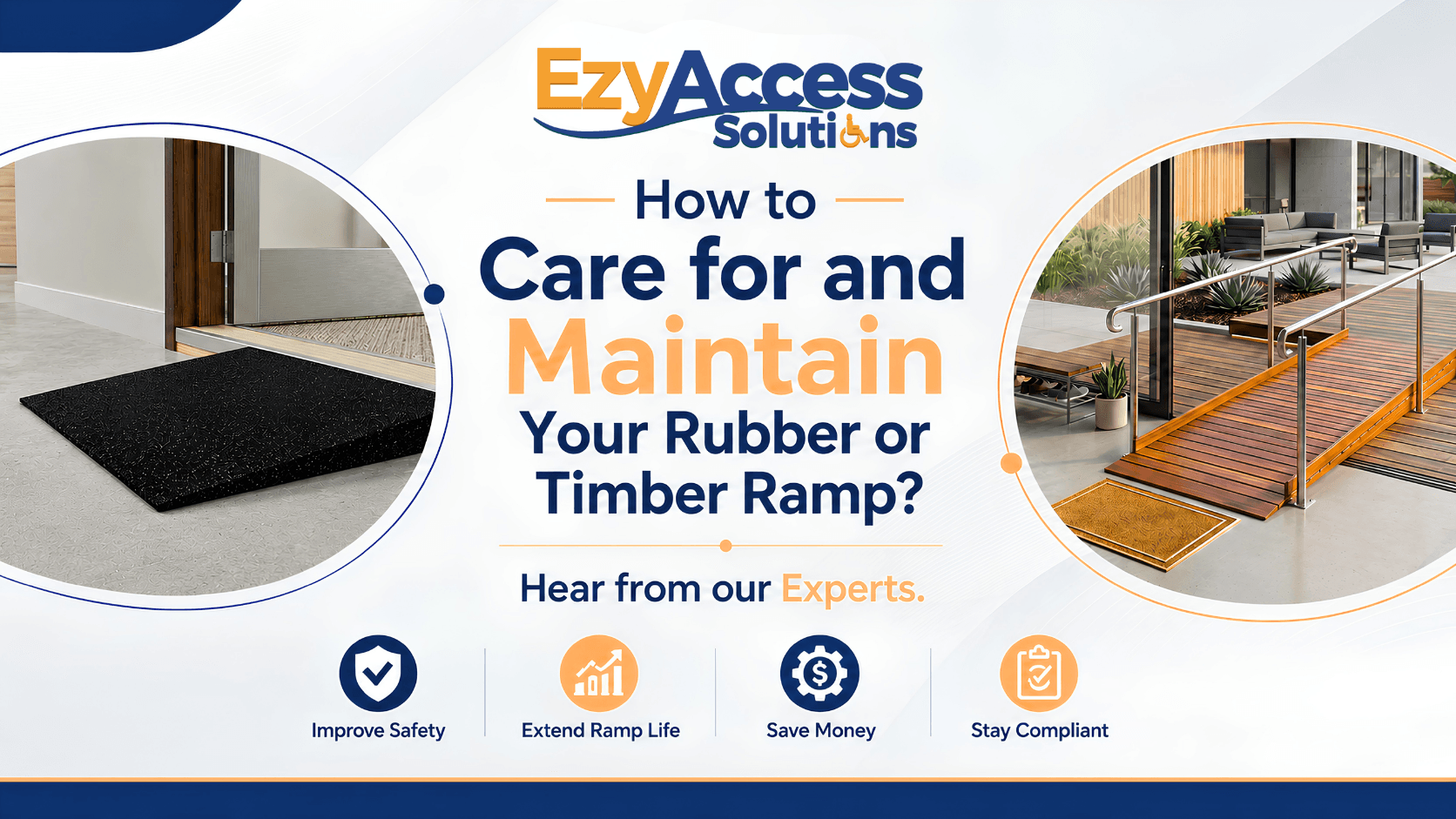
How to Care for and Maintain Your Rubber or Timber Ramp

Quick answer
To maintain a rubber or timber ramp: clean it every 1–2 weeks with mild detergent and water, keep it dry and clear of debris, check it sits flush against the step, and inspect timber ramps every 6 months for cracking, splintering, or loose fixings. Re-seal timber ramps with a weatherproof coating once a year. Rubber ramps need no sealing — just regular cleaning and a visual check for wear.
A rubber or timber ramp is only as safe as the condition it’s kept in. Whether it’s supporting a wheelchair, a mobility scooter, or a walking frame every day, regular care keeps it slip-resistant, structurally sound, and free of the small problems that turn into trip hazards.
At EZY Access Solutions, we build rubber ramps and timber ramps to last — but even the best-made ramp needs a little upkeep. This guide covers exactly how to clean, inspect, and maintain both ramp types so they stay safe for years, whether it’s a standard rubber threshold ramp at a doorway or a custom timber ramp with handrails.
In this article
1. Why ramp maintenance matters
2. How to clean and maintain a rubber ramp
3. How to clean and maintain a timber ramp
4. Warning signs: when to repair or replace
5. Seasonal maintenance tips for Australian conditions
6. Ramp maintenance schedule at a glance
7. FAQs
1. Why Ramp Maintenance Matters
A poorly maintained ramp isn’t just a cosmetic issue — it’s a safety risk. Debris buildup reduces grip, a warped timber board can create an uneven surface, and a ramp that no longer sits flush against a step becomes a trip hazard rather than a solution to one.
Safety — A clean, well-fixed ramp keeps its non-slip grip in wet or dry conditions.
Longevity — Basic care can add years to a ramp’s usable life, rubber or timber.
Compliance — NDIS and aged care settings often require documented, regular equipment checks, and ramps must keep meeting the gradient and handrail requirements set out in AS 1428.1 — Design for Access and Mobility.
Cost — Small, regular maintenance is far cheaper than an early replacement.
Sources: NDIS — What Are Home Modifications (simple ramps as a fundable minor home modification, with ongoing maintenance support) and the National Construction Code Board on AS 1428.1 access requirements.
2. How to Clean and Maintain a Rubber Ramp
EZY Access Solutions rubber ramps are made from 100% recycled, compression-resistant rubber, so they need very little upkeep — but a regular routine keeps them performing at their best. If your step doesn’t match a standard size, a custom rubber ramp can be built to fit exactly:
01. Rinse weekly. Hose down or wipe with water and a mild detergent to remove dirt, leaves, and grit that reduce grip.
02. Avoid harsh chemicals. Solvents and strong degreasers can dry out and crack the rubber surface over time.
03. Check the fit. Make sure the ramp still sits flush against the step — movement over time can leave a gap.
04. Inspect for cracking. Look over the surface every month for splits, especially at the edges and corners.
05. Store flat if removable. Keep it out of direct sun when not in use to prevent warping.
3. How to Clean and Maintain a Timber Ramp
Timber ramps need a bit more attention than rubber, since untreated wood is exposed to moisture, UV, and general wear. Here’s how to keep one in good condition:
01. Sweep and wipe down weekly. Clear leaves, dirt, and standing water so moisture doesn’t sit on the surface.
02. Check fixings every 3 months. Tighten any screws, bolts, or brackets that have loosened with use.
03. Look for splintering or rot. Run a hand along the edges (carefully) and check joints for soft or discoloured wood.
04. Re-seal annually. Apply a weatherproof timber sealant or decking oil once a year, more often in harsh sun or coastal areas.
05. Check handrails separately. Handrails and banister rails take a lot of grip pressure — test they’re still firmly fixed at each post. If grab rails are fitted near the ramp too, give them the same fixing check.
If a section of timber feels soft, spongy, or shows visible rot, don’t wait for it to worsen — this is a sign the board needs replacing, not just re-sealing.
4. Warning Signs: When to Repair or Replace
Cracking or splitting (rubber)
Small surface cracks can often be monitored; deep cracks that flex under weight mean it’s time to replace.
Soft or spongy timber
A sign of rot or water damage underneath the surface — the affected section should be replaced, not just resealed.
Loose fixings or wobble
Any movement underfoot should be fixed immediately — tighten hardware or call a professional.
Gap between ramp and step
Creates a trip hazard — reposition the ramp or get a free quote from EZY Access Solutions for a custom refit.
5. Seasonal Maintenance Tips for Australian Conditions
Australian weather is hard on outdoor ramps — strong UV, sudden downpours, and coastal salt air all take a toll. A few seasonal habits go a long way:
Summer — Check timber for UV drying/cracking; rubber ramps handle heat well but should still be checked for surface softening in extreme temperatures.
Autumn/Winter — Clear wet leaves promptly; both ramp types can become slippery under leaf litter and moisture.
Coastal properties — Rinse off salt spray regularly and check timber fixings more often — salt air speeds up corrosion of screws and brackets. If corrosion becomes an ongoing issue, an aluminium threshold ramp is a lower-maintenance option for exposed coastal entrances.
6. Ramp Maintenance Schedule at a Glance
| Frequency | Rubber ramp | Timber ramp |
|---|---|---|
| Weekly | Rinse/wipe down, clear debris | Sweep, clear standing water |
| Monthly | Check for cracking, confirm flush fit | Visual check for splintering |
| Every 3 months | — | Tighten fixings, check handrails |
| Yearly | Full inspection, reposition if needed | Re-seal/re-oil, full structural check |
7. Frequently Asked Questions
How often should I clean my rubber ramp?
Once a week is enough for most homes — more often in high-traffic commercial settings or after heavy rain.
Do timber ramps need to be sealed?
Yes. Timber ramps should be treated with a weatherproof sealant or decking oil at least once a year to prevent cracking, rot, and UV damage.
Can I pressure wash a rubber or timber ramp?
Low-pressure rinsing is fine, but avoid high-pressure washers on timber — they can strip sealant and force water into joints.
How long does a rubber ramp last with proper care?
A well-maintained EZY Access Solutions rubber ramp typically lasts many years, thanks to its compression-resistant recycled rubber construction.
What should I do if my timber ramp feels soft or spongy?
Stop using that section immediately and contact a professional — soft timber usually means water damage or rot that needs the board replaced.
Does EZY Access Solutions repair or replace worn ramps?
Yes. The Melbourne-based team can assess your existing ramp and recommend a repair, a replacement panel, or a full custom rebuild — get a free quote or book a service to get started.
Need your ramp inspected or replaced?
The EZY Access Solutions team in Epping, Melbourne can inspect, repair, or custom-build a replacement rubber or timber ramp for your home or business.
📞 (03) 7073 2121 | ✉️ [email protected] | 🕐 Mon–Fri 8am–5pm