






Drop-Down Grab Rails for Toilets: Fixed vs Fold-Away — Which One Do You Need?

Standing up from the toilet seems like a small thing — until it isn’t. It’s usually the first place a family notices someone needs extra support, and it’s also the moment where most people start Googling “grab rail for toilet” and immediately hit a fork in the road: fixed, or drop-down?
They solve the same basic problem — a stable point to push up from — but they’re built for genuinely different situations. Picking the wrong one usually means either buying twice, or ending up with a rail that’s technically “there” but not actually the right fit for how the bathroom gets used day to day.
Quick Answer
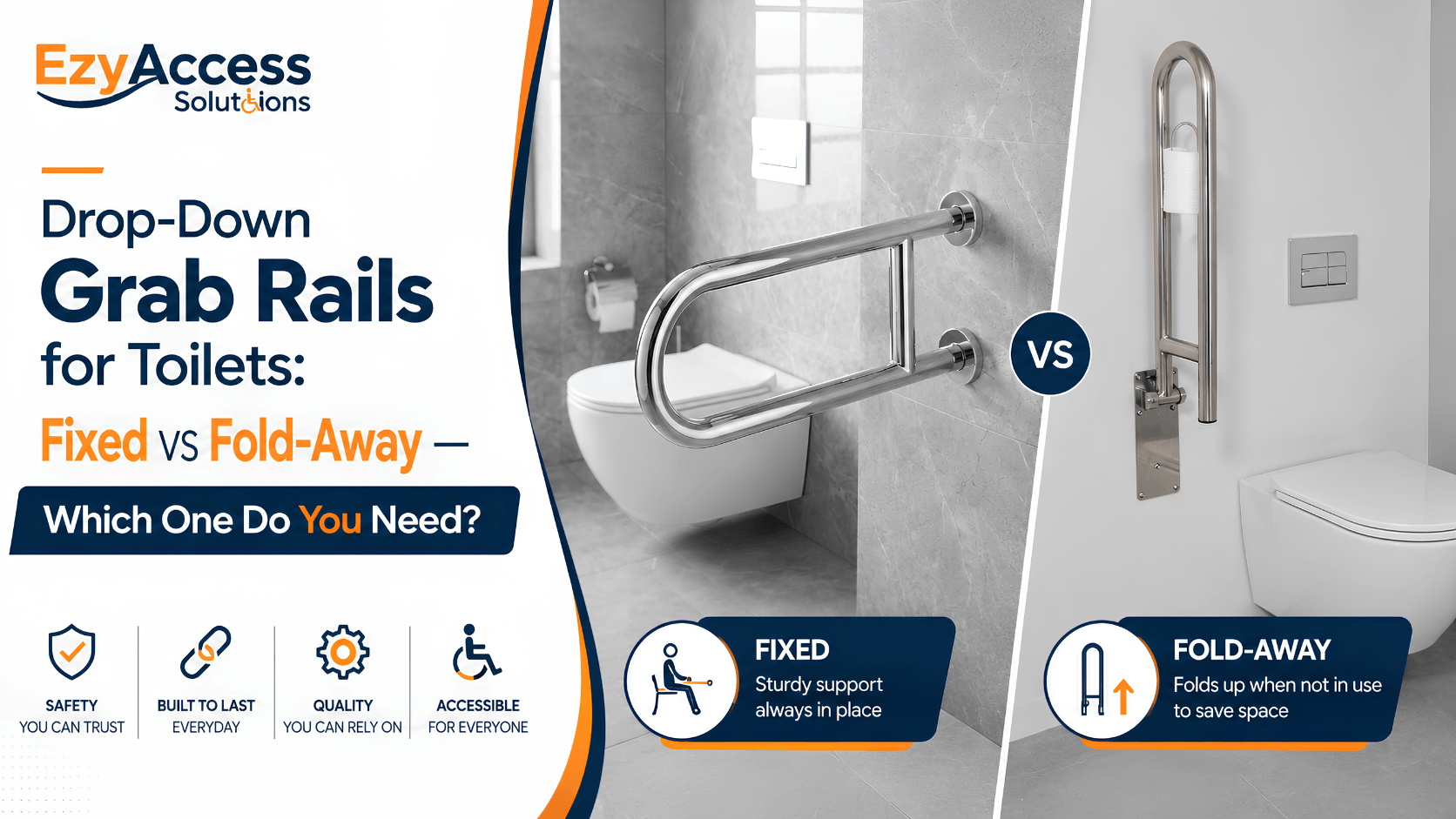
A fixed grab rail is permanently mounted to the wall and offers the highest load rating and stability — the right choice when one person needs consistent, dependable support every time. A drop-down (fold-away) grab rail hinges up out of the way when not needed and folds down for use — better suited to shared or narrow bathrooms, where a permanent rail either gets in the way of other household members or makes the space feel more like a clinical facility than a home. If in doubt: choose fixed for dedicated, single-user support, and drop-down for shared spaces or where floor space beside the toilet is limited.
Fixed vs Drop-Down Grab Rails: Quick Comparison
| Fixed Grab Rail | Drop-Down (Fold-Away) Grab Rail | |
|---|---|---|
| Best for | A dedicated user who needs support every time | Shared bathrooms, visitors, or occasional support |
| Stability | Maximum — rigid, permanently anchored | Strong when locked down, but relies on the hinge mechanism |
| Space | Stays in the same position; can narrow the approach to the toilet | Folds flush to the wall when not in use, freeing up space |
| Look and feel | More visibly “medical” in appearance | Blends in better when folded away — a common choice for families who don’t want the bathroom to feel clinical |
| Typical setting | Single-occupant bathroom, ensuites, aged care rooms | Shared family bathrooms, guest toilets, NDIS homes with multiple users |
| Installation | Requires solid wall reinforcement (stud, noggin or backing plate) | Same reinforcement needed, plus a correctly rated hinge mechanism |
What Is a Drop-Down Grab Rail?
A drop-down grab rail — sometimes called a fold-away or hinged grab rail — mounts to the wall on one end and swings down into position when needed, then folds back up flush against the wall when it’s not. It’s designed for situations where a permanent rail sticking out from the wall would either be in the way, or simply isn’t needed by everyone who uses that bathroom.
This makes it a common choice in:
- Shared family bathrooms, where only one household member needs the support
- Guest toilets, where visitors with different mobility needs come and go
- NDIS or Home Care Package homes, where the goal is often to support one person’s needs without making the whole bathroom feel institutional for everyone else who uses it
What Is a Fixed Grab Rail?
A fixed grab rail is bolted directly to the wall in one permanent position. Because there’s no moving mechanism, it generally carries the highest load rating and the most consistent, dependable feel underhand — there’s nothing to unfold, nothing to line up, and nothing that can be left in the wrong position by someone in a hurry.
This makes fixed rails the more common recommendation for:
- A single-occupant bathroom or ensuite where only one person needs support
- Higher support needs, where maximum stability matters more than the rail folding away
- Aged care and clinical-style environments, where consistency of use matters more than appearance
Which One Do You Actually Need?
A few questions usually settle it:
Does more than one person use this bathroom?
If yes, and only one of them needs the rail, a drop-down rail avoids the rest of the household having to navigate around a permanent fixture every day.
How much floor space is beside the toilet?
In a tight bathroom, a fixed rail projecting from the wall can actually make the approach to the toilet harder to navigate for anyone with a walking frame or wheelchair. A drop-down rail folds away and gets that space back when it’s not needed.
How much support is actually needed?
For higher support needs, a fixed rail is generally the safer recommendation — it’s simpler, stronger, and there’s no hinge or lock mechanism to check before every use.
Does the look of the bathroom matter to the household?
Families renovating an ageing parent’s bathroom often prefer a drop-down rail specifically because it doesn’t make the room look like a care facility when it’s folded away — the same reasoning behind most ageing-in-place bathroom upgrades.
Installation Matters More Than the Rail Itself
Whichever type you choose, the rail is only as strong as what it’s bolted into. Grab rails need to be anchored into a stud, noggin, or a solid backing plate — not just plasterboard — because they’re rated to take a person’s full body weight in a single, sudden movement. This is one of the areas where professional installation is genuinely worth it: a rail that looks secure but is only screwed into plasterboard can fail exactly when it’s needed most.
Australian Standards recommend a rail diameter of 30–50mm for a secure, comfortable grip, and while AS1428.1 is written primarily for public and commercial buildings, it’s the reference framework most occupational therapists and installers use when specifying rails for private homes — particularly where the installation needs to align with NDIS documentation.
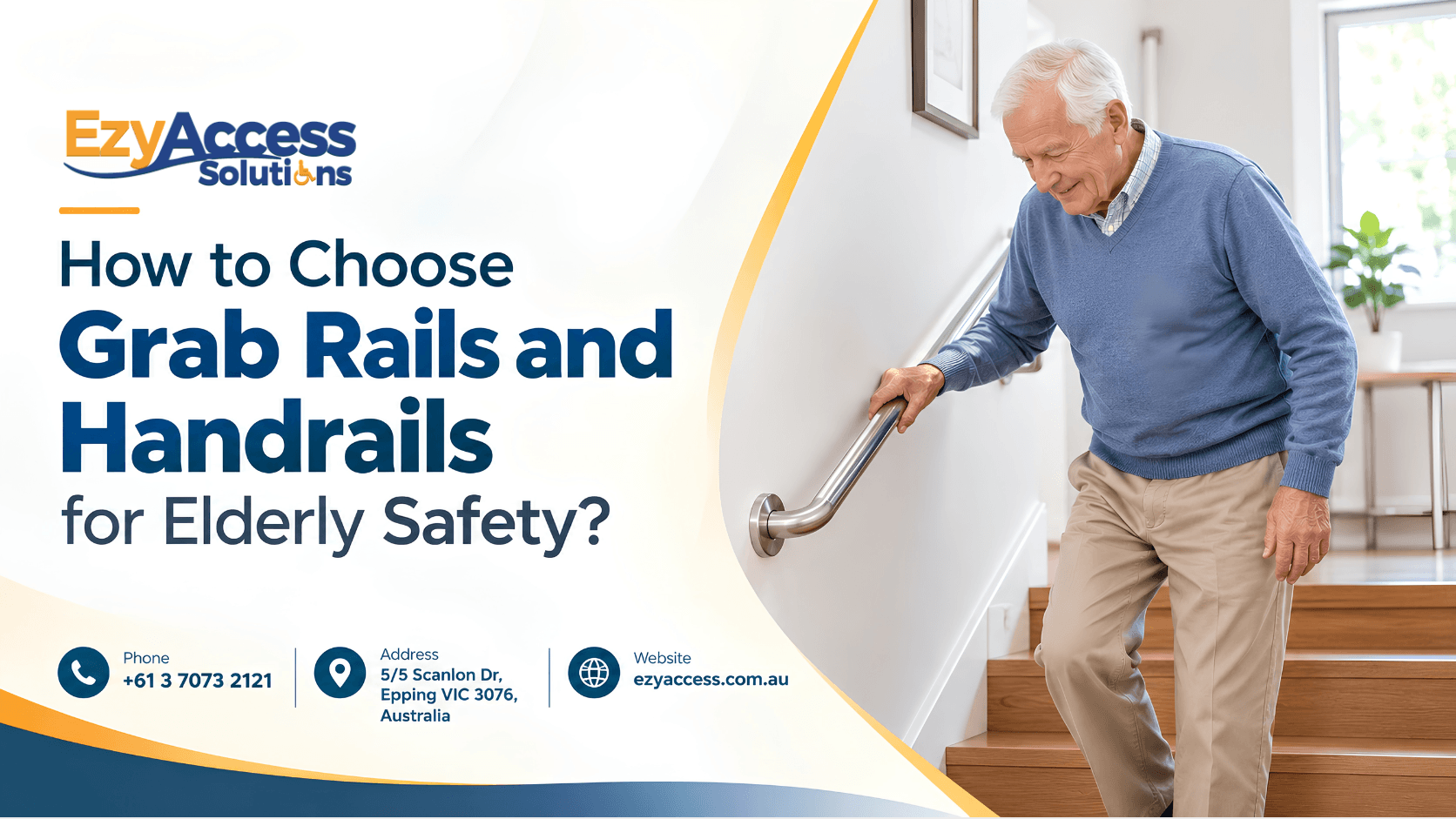
If you’re weighing up grab rails against handrails more broadly, our guide to choosing grab rails and handrails for elderly safety covers the difference between the two and where each is typically used around the home.
Can NDIS or Home Care Packages Fund a Grab Rail?
Often, yes. Grab rails are one of the more common minor home modifications funded through NDIS or a Home Care Package, particularly when they’re recommended as part of an occupational therapy assessment. Whether a fixed or drop-down rail is specified usually comes down to the OT’s assessment of the household’s needs — which is exactly the kind of detail worth confirming before you order.
Frequently Asked Questions
Are drop-down grab rails as strong as fixed ones?
When installed correctly into solid wall backing, a quality drop-down rail can hold comparable weight to a fixed rail. The difference is mechanical — a drop-down rail has a hinge and lock point that needs to be used correctly every time, whereas a fixed rail has no moving parts at all.
Can a grab rail be installed on any wall?
Only if there’s solid backing behind the plasterboard — a stud, noggin, or reinforced backing plate. If your bathroom wall doesn’t already have this, it can usually be added during installation.
Do I need an OT assessment to get a grab rail installed?
Not always for a straightforward home purchase, but if you’re seeking NDIS or Home Care Package funding, an occupational therapy assessment is usually required to confirm the right type, position and height for your situation.
What’s the right height for a toilet grab rail?
This varies by user height and the specific toilet, which is why a proper assessment — rather than a generic measurement — gives the safest result.
Can I get a rail that suits both a wheelchair user and other family members?
Yes — this is exactly the scenario drop-down rails are designed for, since they provide full support when needed and fold away completely for everyone else.
Not sure which rail suits your bathroom? Explore our full Grab Rails range or get a free, no-obligation quote and our Melbourne team will help you choose between fixed and drop-down based on your actual space and needs.


One thought on “Drop-Down Grab Rails for Toilets: Fixed vs Fold-Away — Which One Do You Need?”
Comments are closed.