



How to Choose Grab Rails and Handrails for Elderly Safety: A Complete Guide?
Every year, thousands of older Australians are hospitalised following a fall at home. Many of those falls happen in bathrooms, on staircases, and at doorways — the exact locations where a correctly installed grab rail or handrail could have made all the difference. Yet despite being one of the most cost-effective safety interventions available, grab rails remain one of the most overlooked home modifications for ageing Australians.
This guide explains everything you need to know about choosing, positioning, and installing grab rails and handrails for elderly safety — whether you are planning a home modification for yourself, a parent, or a client under an NDIS plan or Home Care Package.
What Is the Difference Between a Grab Rail and a Handrail?
The terms are often used interchangeably, but they serve distinct purposes and are installed differently.
Grab rails are short, fixed supports typically installed in bathrooms, toilets, and near doorways. They are designed to be gripped momentarily during a specific action — lowering onto a toilet seat, stepping into a shower, or rising from a chair. They provide a stable anchor point at the exact moment it is needed most.
Handrails are longer continuous supports installed along staircases, ramps, corridors, and outdoor pathways. They are designed to be held throughout an entire movement sequence — walking up a flight of stairs, moving along a ramp, or navigating an extended hallway.
Both are essential components of a comprehensively accessible home, and in many cases a well-designed modification plan will incorporate both.
Why Grab Rails and Handrails Matter for Elderly Safety
The statistics surrounding falls among older Australians are sobering. Falls are the leading cause of injury-related death for Australians aged 65 and over, and approximately one in three people in this age group falls at least once per year. The consequences — hip fractures, head injuries, prolonged hospitalisation, and loss of confidence — can be life-changing.
The bathroom is the highest-risk room in any home. Wet, slippery surfaces combined with the physical demands of bathing, toileting, and dressing create conditions that challenge balance and stability even for relatively fit older adults. For anyone with reduced lower limb strength, impaired balance, or a neurological condition, the bathroom without grab rails is a genuine hazard.
The good news is that grab rail installation is one of the most evidence-supported fall prevention interventions available. Properly specified and correctly installed grab rails reduce fall risk, increase independence, and give older adults — and their families — genuine confidence.
Where Should Grab Rails Be Installed?
The placement of grab rails is not arbitrary. Each installation should be guided by a functional assessment of the individual’s specific movements, limitations, and home layout. That said, there are established high-priority locations that apply in the vast majority of homes.
Shower and Bath
The shower recess is the single highest-priority location for grab rail installation. At minimum, a horizontal grab rail on the wall opposite the showerhead provides support during entry, exit, and the standing phase of showering. A vertical or angled rail near the shower entry assists with the step-over action, which is where many bathroom falls occur.
For baths, a grab rail along the long wall of the bath assists with lowering and rising — the two most physically demanding actions involved in bathing. A rail near the taps provides additional support during transfers.
Toilet
Rising from a seated position is one of the most demanding functional tasks for older adults with reduced lower limb strength or hip and knee pain. A horizontal or angled grab rail positioned beside the toilet — at the correct height for the individual user — allows the person to push down as they rise, dramatically reducing the effort required and the risk of losing balance.
In many bathrooms, a swing-down (folding) grab rail on one side of the toilet is an effective solution where fixed rails on both sides are not practical due to space constraints.
Shower Entry and Bathroom Doorway
The transition from a dry floor to a wet shower recess, or from a carpeted hallway to a tiled bathroom, creates a moment of instability that is easily underestimated. A vertical grab rail at the shower entry and near the bathroom door provides a stable handhold at these transition points.
Staircase and Steps
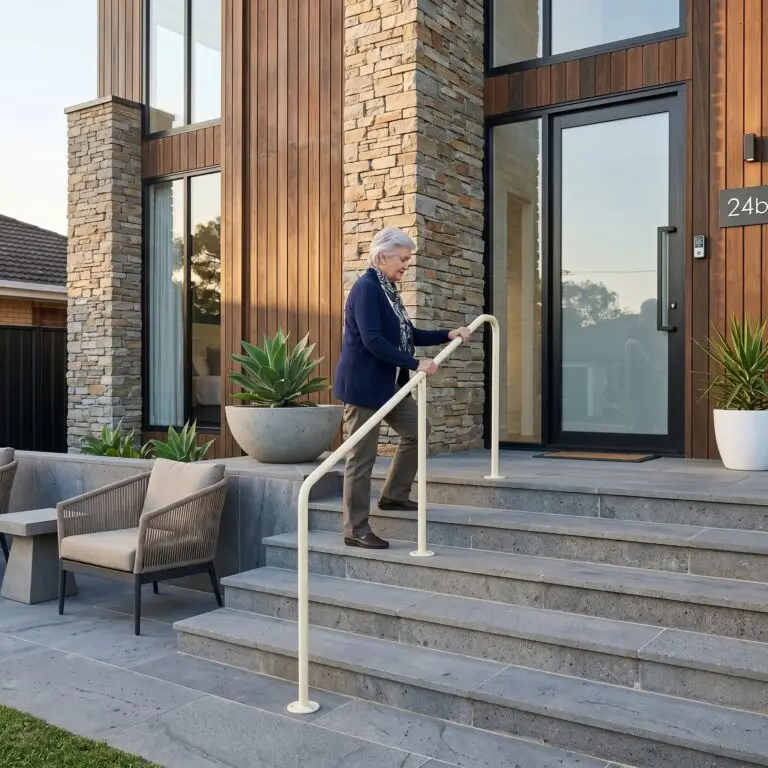
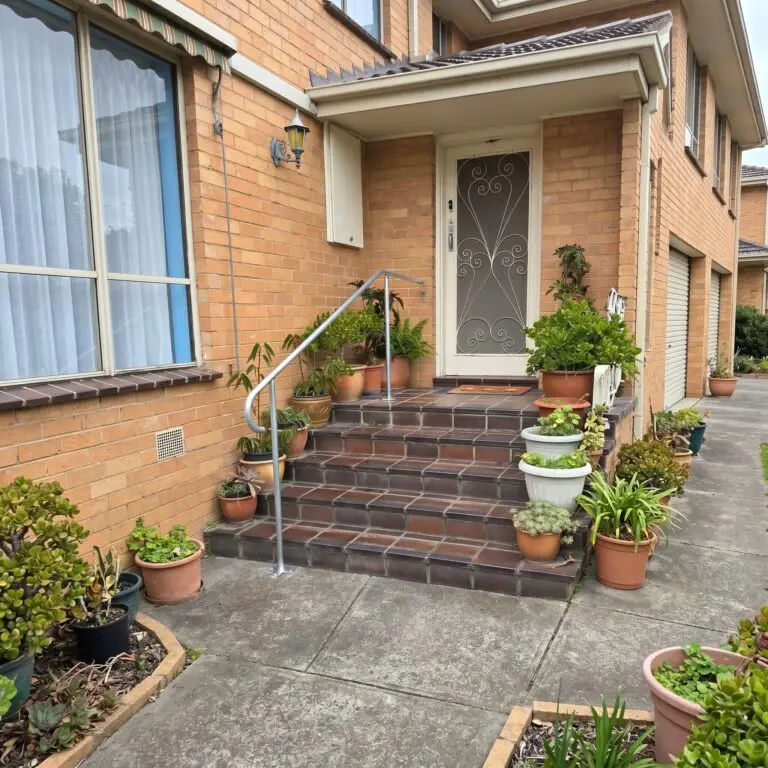
Any staircase in a home occupied by an older adult should have at minimum one continuous handrail running the full length of the stairs, installed at the correct height (typically 865mm to 1000mm from the stair nosing, per Australian Standards). Where possible, handrails on both sides of the staircase are preferable — particularly for individuals who have greater strength or stability on one side than the other.
Outdoor steps at the front entry, back door, or garage are frequently overlooked but represent a significant fall risk, particularly when wet. A stainless steel or powder-coated aluminium handrail at these locations is a straightforward and cost-effective safety measure.
Ramp Handrails
Where a ramp has been installed to provide wheelchair or mobility aid access, handrails along both sides of the ramp are required under Australian Standards for any ramp over a certain length. Even for shorter ramps where rails are not mandatory, they provide meaningful support for ambulant users and those with reduced upper body stability.
Bedroom and Living Areas
Grab rails are not limited to wet areas and staircases. A bed transfer rail — a short vertical or angled rail positioned beside the bed — can make the difference between independent rising and dependence on a carer for one of the most frequent daily activities. Similarly, a rail near a favourite chair or lounge seat can restore independence for individuals who struggle to rise from low seating.
How to Choose the Right Grab Rail: Key Specifications
Not all grab rails are equal. Selecting the right product involves several important considerations.
Load Capacity
A grab rail is only as safe as its load capacity and its fixing. The rail itself must be rated to support the forces applied during use — which can significantly exceed a person’s body weight during a near-fall event. Look for rails tested and rated to a minimum of 1.1 kilonewtons (approximately 112kg) of static load. Always confirm that the wall substrate can support the required fixings.
Material and Finish
Stainless steel is the most common and most durable material for grab rails in wet areas. It resists corrosion, is easy to clean, and maintains its structural integrity over time. Powder-coated steel is an alternative in dry areas and outdoor environments. Avoid chrome-plated rails in wet areas, as the chrome layer can deteriorate over time and compromise the structural integrity of the rail.
For grip texture, a knurled or ribbed surface provides significantly better grip than a smooth polished finish — an important consideration for users with reduced hand strength or sensation.
Diameter
The diameter of the rail affects how securely it can be gripped. Australian Standards recommend a rail diameter of 30mm to 50mm for most applications. A diameter at the lower end of this range (around 32mm) suits users with smaller hands or reduced grip strength. Larger diameters are better suited to users who rely primarily on wrist or forearm support.
Length and Orientation
Grab rail length should be determined by the specific action it is supporting. A rail that is too short does not provide support throughout the full range of movement; a rail that is too long may create an obstacle. As a general guide:
- Toilet grab rails: 600mm to 900mm horizontal length
- Shower entry rails: 600mm to 900mm vertical or angled
- Shower interior rails: 900mm to 1200mm horizontal
- Bath rails: 900mm to 1200mm horizontal
Orientation — horizontal, vertical, or angled — should be chosen based on the movement being supported. Horizontal rails assist with lateral balance and weight-bearing through a standing posture. Vertical rails assist with gripping during a rising or lowering action. Angled rails (typically at 45 degrees) are versatile and can support both functions, making them a popular choice in compact bathrooms.
Installation: Why Professional Fitting Matters
A grab rail that is improperly installed is potentially more dangerous than no grab rail at all. If a rail fails under load — due to inadequate fixings, incorrect wall substrate identification, or improper product selection — the consequences can be severe.
Professional installation by an experienced accessibility modifier ensures that:
- The correct wall substrate is identified (timber stud, steel stud, masonry, or tiled surface over various substrates)
- The appropriate fixing method and hardware is used for that substrate
- The rail is positioned at the correct height and orientation for the specific user
- The installation meets relevant Australian Standards and any NDIS or aged care compliance requirements
At Ezy Access Solutions, our Melbourne installation team handles grab rail and handrail fitting as part of our complete home modification service. We conduct an on-site assessment, confirm the wall substrate, select the appropriate product and fixings, and complete the installation to standard — giving you confidence that the rail will perform when it is needed most.
Australian Standards for Grab Rails and Handrails
The primary Australian Standard governing grab rails and handrails in accessible environments is AS 1428.1 – Design for Access and Mobility. This standard specifies requirements for rail diameter, load capacity, surface texture, fixing strength, and installation dimensions in publicly accessible buildings.
While AS 1428.1 applies primarily to public buildings and commercial environments, it provides the reference framework used by Occupational Therapists and accessibility modifiers when specifying rails for private residential use. NDIS-funded modifications are generally expected to align with these standards.
Request a Free Assessment or Quote
If you are ready to improve safety and independence at home — for yourself, a family member, or an NDIS or Home Care Package client — the team at Ezy Access Solutions is here to help.
We offer professional grab rail and handrail assessment, supply, and installation across Melbourne and surrounding areas, with products available for supply-only Australia-wide.
Contact us today:
- Phone: (03) 7073 2121
- Email: [email protected]
- Address: 5/5 Scanlon Drive, Epping VIC 3076
- Hours: Monday to Friday, 8:00am – 5:00pm
Or click ezyaccess.com.au/handrails-grab-rails to explore our full range of handrails, grab rails, and home accessibility solutions.
Satisfied Clients
We specialise in designing and building safe, functional, and NDIS-compliant spaces that help people live comfortably and independently at home.
We recently contacted Ezy Access Solutions for a rubber ramp installation at our home. The team was very professional and easy to deal with. The ramp fits perfectly and feels very solid and safe. Installation was quick and tidy. Highly recommend their services if you need quality access solutions.
Daniel Carter
Great experience ordering rubber ramps from Ezy Access Solutions. The communication was clear and delivery was faster than expected. The ramp quality is excellent and made from recycled rubber which is a big plus. Very happy with the purchase.
Lisa Bennet
Ezy Access Solutions installed a rubber ramp for my parents’ house and it has made a huge difference for wheelchair access. The team was punctual, polite and completed the job quickly. The ramp looks great and is very sturdy. Thank you for the excellent service.
Kirsty Blundell
Ordered several rubber ramps for our warehouse loading area. Very impressed with the build quality and durability. Delivery was smooth and everything arrived in perfect condition. Reliable company and great product.