



Aluminium Threshold Strips for Doorways and Floor Transitions

When flooring is installed or renovated, the transition between two surfaces can easily be overlooked. A small gap between carpet and tile, an exposed edge at a doorway or a slight change between adjoining surfaces may not seem significant at first. Over time, however, these areas can collect dirt, suffer edge damage or become uncomfortable for people and mobility equipment to cross.
This is where aluminium threshold strips provide a practical solution.
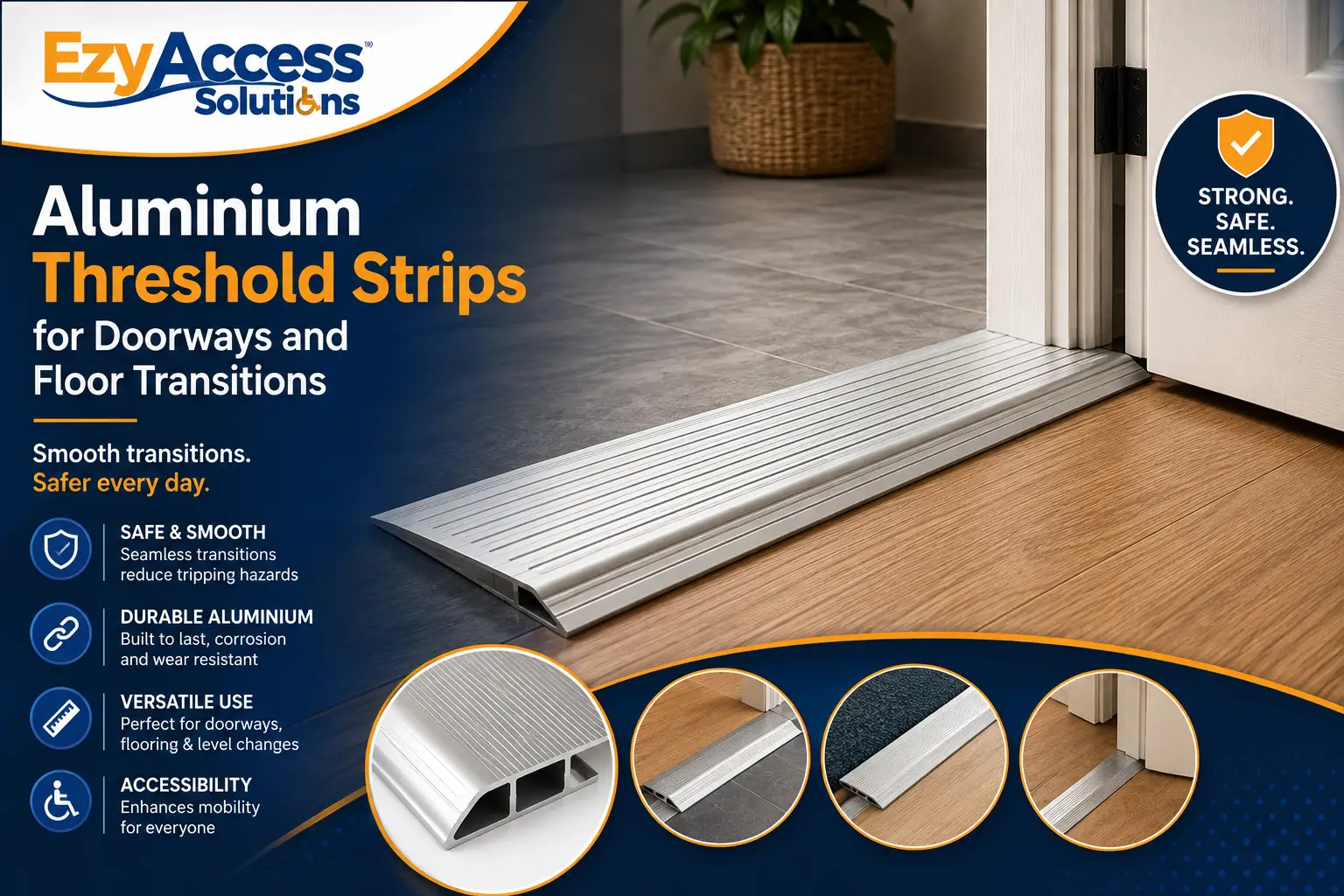
Aluminium threshold strips are designed to create smoother, safer and more professional transitions between adjoining floor surfaces. They can be installed across doorways, entrance points and flooring joins where two materials meet.
At Ezy Access Solutions, aluminium threshold strips are available for residential, commercial and accessibility-focused environments across Australia. Made from premium high-grade anodised aluminium, they provide a durable, low-profile finish that helps protect flooring edges and reduce everyday obstacles.
What Are Aluminium Threshold Strips?
Aluminium threshold strips are slim metal profiles installed over the point where two floor surfaces meet. They are commonly used across doorways, room transitions, entry points and flooring joins.
A threshold strip may be used when joining:
- Carpet and tile
- Timber and vinyl
- Laminate and concrete
- Hybrid flooring and tiles
- Carpet and timber
- Vinyl and concrete
- Two sections of similar flooring
The strip bridges the join and covers exposed flooring edges, creating a cleaner and more continuous transition.
Ezy Access Solutions aluminium threshold strips feature a low-profile flush design. This helps the strip sit neatly against adjoining floor surfaces without creating unnecessary bulk across the doorway.
Unlike an aluminium threshold ramp, which is used to manage a more noticeable change in height, an aluminium threshold strip is generally intended for level or near-level floor transitions.
Why Floor Transitions Need Proper Protection
Different flooring materials do not always meet perfectly. Carpet, tiles, vinyl, timber, laminate and concrete may have different thicknesses, installation requirements and edge profiles.
Even when two surfaces are close to the same height, the join may remain exposed.
An unfinished flooring transition can lead to several problems. Carpet edges may begin to fray, vinyl may lift, laminate edges may chip and small gaps may collect dirt or moisture. Shoes, walkers, wheelchair castors, prams and cleaning equipment may also catch on an exposed edge.
A properly fitted aluminium threshold strip helps protect these vulnerable areas. It covers the join, supports a more consistent path and gives the flooring a professionally completed appearance.
The full-length slip-resistant surface of Ezy Access Solutions threshold strips also provides additional grip underfoot in wet and dry conditions.
Aluminium Threshold Strips for Doorways
Doorways are among the most common places to install aluminium threshold strips.
One room may have carpet while the adjoining room has tiles. A hallway may meet vinyl flooring in a bathroom or laundry. A timber living area may connect with a tiled kitchen, while a front entrance may bring together internal flooring and an external surface.
Without a suitable threshold treatment, these joins can become worn, untidy or awkward to cross.
An aluminium threshold strip for doorways creates a defined transition between the two areas. It helps protect the flooring edges while maintaining a slim, flush profile across the opening.
These strips may be useful in homes occupied or visited by:
- Older adults
- People using walkers
- Wheelchair users
- Families with young children
- People with reduced balance or mobility
- Anyone moving prams or wheeled equipment between rooms
A carefully selected and securely installed threshold strip can make everyday movement through the doorway feel smoother and more predictable.
Supporting Safer and More Accessible Movement
Small flooring edges can create noticeable obstacles for people with limited mobility.
A person walking without assistance may step over a flooring join without noticing it. For someone using a wheelchair, walking frame or mobility scooter, the same edge may interrupt movement or require additional effort.
The low-profile design of an aluminium threshold strip can help create a more continuous path when the adjoining floors are level or nearly level. The slip-resistant surface also supports more confident footing across the transition.
This makes aluminium threshold strips suitable for locations such as:
- Private homes
- Independent living environments
- Aged care facilities
- Medical centres
- Rehabilitation spaces
- Supported accommodation
- Community buildings
- NDIS-funded home modification projects
The product selected must still suit the particular doorway, floor surfaces and mobility requirements. A larger height difference may require a threshold ramp or a custom access solution rather than a flat threshold strip.
Protecting Flooring Edges From Wear
The edge of a flooring material is often more vulnerable than the main floor surface.
Repeated foot traffic can loosen carpet edges, damage timber ends, chip laminate or cause vinyl to lift. This is particularly common around entrances, corridors and frequently used doorways.
An aluminium threshold strip helps shield the flooring edge from daily contact. The strip receives much of the pressure from shoes, mobility aids, prams, trolleys, vacuum cleaners and other equipment moving across the join.
Ezy Access Solutions threshold strips are manufactured from premium anodised aluminium that is resistant to corrosion, rust, UV exposure and scratching. This makes them suitable for regular use in both residential and commercial environments.
For commercial properties, protecting floor transitions may also help reduce disruptive repairs. Replacing damaged flooring in an office, retail entrance, aged care hallway or busy corridor can be costly and inconvenient.
A cover strip aluminium profile is one of the most practical ways to bring the job together. It hides minor imperfections and gives the floor a deliberate finish rather than a patched up look.
For builders and tradies, this can save time on site. Instead of trying to make two surfaces meet perfectly, the right aluminium strip provides a reliable finish that looks clean and performs well. For homeowners, it creates that satisfying final detail that makes the renovation feel complete.
Why Anodised Aluminium Is Well Suited to Threshold Strips
Aluminium combines strength with a lightweight and low-profile form. The anodised finish provides additional protection while giving the strip a neat, professional appearance.
The material is suitable for indoor and outdoor applications and performs well in areas exposed to regular foot traffic.
Other practical advantages include:
Durability
Premium high-grade anodised aluminium provides a strong threshold solution for busy doorways and floor transitions. It is suited to homes, offices, retail premises, aged care facilities and other commercial environments.
Slip Resistance
Ezy Access Solutions aluminium threshold strips feature a slip-resistant surface extending along the full length of the product. This provides additional grip in both wet and dry conditions.
Low Maintenance
The anodised surface requires minimal maintenance. Routine cleaning with a damp cloth and mild detergent is generally sufficient.
Professional Appearance
The clean aluminium finish works with a wide variety of flooring styles, including tiles, timber, carpet, vinyl and concrete. It creates a tidy transition without dominating the surrounding design.
Indoor and Outdoor Suitability
The aluminium construction is resistant to corrosion, rust, UV exposure and scratching. This allows the strips to be considered for suitable indoor, outdoor and semi-exposed locations.
Straightforward Installation
Pre-drilled fixing holes allow the strips to be installed using standard screws and fixings. No specialist tools are normally required, although the installation method must suit the floor substrate.
Where Aluminium Threshold Strips Can Be Used
Aluminium threshold strips can be used in a wide range of residential, commercial and accessibility-focused environments.
Residential Properties
Within homes, threshold strips may be installed across:
- Bedroom doorways
- Bathroom entrances
- Laundry entrances
- Kitchens
- Hallways
- Living rooms
- Front and back entrances
- Sliding-door thresholds
- Garages
- Patio entrances
They are particularly useful during renovations where a new flooring material needs to connect with an existing surface.
Commercial Properties
Commercial environments usually experience heavier and more consistent traffic. Aluminium threshold strips may be used in:
- Offices
- Retail shops
- Hotels
- Restaurants
- Medical centres
- Schools
- Apartment buildings
- Warehouses
- Community centres
- Aged care facilities
The durable anodised construction and slip-resistant surface make the strips suitable for busy areas where flooring protection and reliable foot contact are important.
Different Widths and Lengths for Different Transitions
Floor transitions are not all the same size. A standard doorway may require a narrow profile, while a wider entrance or flooring join may need greater surface coverage.
Ezy Access Solutions offers aluminium threshold strips in four widths:
- 50 mm
- 75 mm
- 100 mm
- 150 mm
Each width is available in three lengths:
- 1000 mm
- 1500 mm
- 2000 mm
The 50 mm profile is suitable for standard door thresholds and compact flooring joins where a slim finish is preferred.
The 75 mm strip provides broader coverage and may suit larger door frames, wider transition gaps and areas with regular pedestrian traffic.
The 100 mm profile offers greater coverage for wide entries, larger flooring joins and demanding commercial applications.
The 150 mm strip is the extra-wide option. It is intended for large doorways, wide entry thresholds and areas where narrower strips would not provide enough coverage.
All available sizes use a low-profile design and full-length slip-resistant surface.
Choosing the Right Aluminium Threshold Strip
Before selecting a threshold strip, inspect and measure the transition carefully.
Check the Floor Surfaces
Identify the materials being joined. Carpet-to-tile transitions may have different fixing requirements from timber-to-vinyl or concrete-to-laminate transitions.
Measure the Transition Width
Measure the complete area that needs to be covered. The strip must extend securely over the adjoining flooring edges without being unnecessarily wide.
Measure the Required Length
Ezy Access Solutions threshold strips are available in 1000 mm, 1500 mm and 2000 mm lengths. The strip can also be cut to suit a specific doorway or installation area using suitable metal-cutting equipment.
Assess the Height Difference
A low-profile threshold strip is intended for flat or near-level transitions. If one floor is noticeably higher than the other, an aluminium threshold ramp, rubber ramp or custom product may be more suitable.
Consider Foot Traffic
A bedroom doorway generally receives less traffic than a retail entrance, aged care hallway or commercial corridor. Wider strips may provide greater coverage and stability in busy locations.
Review Moisture and Weather Exposure
Bathrooms, laundries, entrance doors and outdoor areas may be exposed to moisture. The aluminium strip is suitable for wet and dry conditions, but the fixings and installation method must also suit the environment.
Consider Mobility Requirements
Where wheelchairs, walking frames, prams or trolleys regularly pass through the doorway, choose a profile that covers the flooring join properly and maintains the smoothest practical transition.
Aluminium Threshold Strips for Renovations
Renovations frequently involve connecting old and new flooring.
A homeowner may replace carpet with vinyl planks but retain tiles in the adjoining room. A new bathroom floor may need to meet an existing hallway surface. Removing an internal wall may also expose an untidy join between two flooring materials.
It is not always practical to replace every floor simply to create a perfectly matched transition.
An aluminium threshold strip provides a clean way to finish the join. It can cover minor imperfections, protect the edges and give the completed renovation a more deliberate appearance.
The availability of four widths and three lengths makes it easier to select a strip that suits the size of the doorway or transition.
For builders and flooring installers, the pre-drilled fixing holes also simplify installation. Standard screws can be used, subject to the material beneath the flooring and the requirements of the site.
Threshold Strips in High-Traffic Areas
Commercial entrances, retail spaces, corridors and shared facilities require products that can withstand repeated use.
A loose, damaged or unfinished flooring transition may affect safety, interrupt cleaning routines and create an unprofessional appearance. It may also allow surrounding flooring materials to lift or deteriorate.
Aluminium threshold strips are suitable for high-traffic areas because they combine durable anodised construction with a slim, flush profile.
When correctly selected and installed, they help:
- Protect exposed flooring edges
- Minimise catching points
- Provide additional slip resistance
- Support movement of wheeled equipment
- Improve the appearance of transition areas
- Create a more consistent path through the building
The 75 mm, 100 mm and 150 mm profiles may be particularly useful where broader coverage is required. Regular inspections should still be carried out to confirm that the strip and fixings remain secure.
Installation and Ongoing Care
Aluminium threshold strips should be measured, cut and positioned carefully before installation.
The strip must sit evenly across the flooring join and cover both edges sufficiently. Pre-drilled fixing holes make installation more straightforward, and standard screws or fixings can be used.
The exact fixing method will depend on the surface beneath the strip. Timber, tiles, concrete and other substrates may require different screws, plugs or preparation.
No specialist installation tools are generally required. A screwdriver or drill may be sufficient for fixing, while a hacksaw or suitable metal-cutting blade can be used if the strip needs to be shortened.
After installation, maintenance is simple. Wipe the surface with a damp cloth and mild detergent when required. Avoid cleaning products or abrasive tools that may damage the surrounding flooring.
The strip and fixings should also be checked periodically, especially in high-traffic or outdoor locations.
Why Choose Ezy Access Solutions?
Ezy Access Solutions provides practical products designed to improve everyday movement through Australian homes, workplaces and community environments.
Its aluminium threshold strip range includes:
- Four width options from 50 mm to 150 mm
- Three lengths from 1000 mm to 2000 mm
- Premium high-grade anodised aluminium
- A full-length slip-resistant surface
- Pre-drilled fixing holes
- Indoor and outdoor suitability
- Resistance to corrosion, rust, UV exposure and scratches
- A 12-month manufacturer warranty
- Suitability for residential, commercial and accessibility-focused applications
The aluminium threshold strips are also described as suitable for NDIS-funded home modification plans. Approval should be confirmed with the relevant occupational therapist, plan manager or funding provider before purchase.
Customers who are uncertain whether they need a threshold strip, threshold ramp or another access product can contact the Ezy Access Solutions team for product guidance.
Complete Your Floor With Aluminium Threshold Strips
A flooring transition may be a small part of a room, but it can influence safety, accessibility, appearance and long-term durability.
An unfinished join can expose flooring edges, collect dirt and interrupt movement. A correctly selected aluminium threshold strip provides a low-profile transition while protecting the surrounding surfaces from regular wear.
With four widths, three lengths, slip-resistant surfaces and durable anodised construction, Ezy Access Solutions aluminium threshold strips provide a practical choice for homes, offices, shops, aged care facilities and commercial properties.
Explore the aluminium threshold strip range from Ezy Access Solutions or contact the team for assistance selecting the correct width and length for your doorway or flooring transition.
Frequently Asked Questions
Aluminium threshold strips bridge joins between level or near-level flooring surfaces. They help protect exposed edges, create smoother transitions and provide a neat finish across doorways and flooring joints.
No. Threshold strips are low-profile products for flat or nearly flat floor transitions. Threshold ramps are designed to address a more noticeable step, lip or change in height.
They can be used with common flooring materials such as carpet, tiles, timber, vinyl and concrete. The correct fixing method must be selected for the floor and substrate.
Ezy Access Solutions offers aluminium threshold strips in 50 mm, 75 mm, 100 mm and 150 mm widths. Narrower strips suit compact joins, while wider profiles provide greater coverage for larger entries and transitions.
The aluminium threshold strips are available in 1000 mm, 1500 mm and 2000 mm lengths. They can also be cut to suit a particular doorway or transition.
Yes. Ezy Access Solutions aluminium threshold strips have a full-length slip-resistant surface designed to provide additional grip in wet and dry conditions.
Yes. The anodised aluminium construction is resistant to corrosion, rust, UV exposure and scratching, making the strips suitable for appropriate indoor and outdoor applications.
The strips include pre-drilled fixing holes and can be installed using standard screws and fixings. No specialist tools are normally required, although the fixing method must suit the installation surface.
The product range is described as suitable for NDIS-funded home modification plans. Customers should confirm product suitability and funding approval with the relevant occupational therapist, plan manager or NDIS representative.
Clean the strip using a damp cloth and mild detergent. Inspect the fixings periodically and tighten or replace them if the strip becomes loose.